

Understanding the What Meaning Suffix concept helps learners decode words more easily and improve their vocabulary. In English grammar, suffixes are added at the end of root words to change meaning or form, such as turning verbs into nouns or adjectives into new variations.
Learning common suffix meanings, examples, and usage patterns supports better reading, writing, and word recognition. This guide explains suffix definitions in simple language so every learner can understand how word endings shape meaning.
What Meaning Suffix
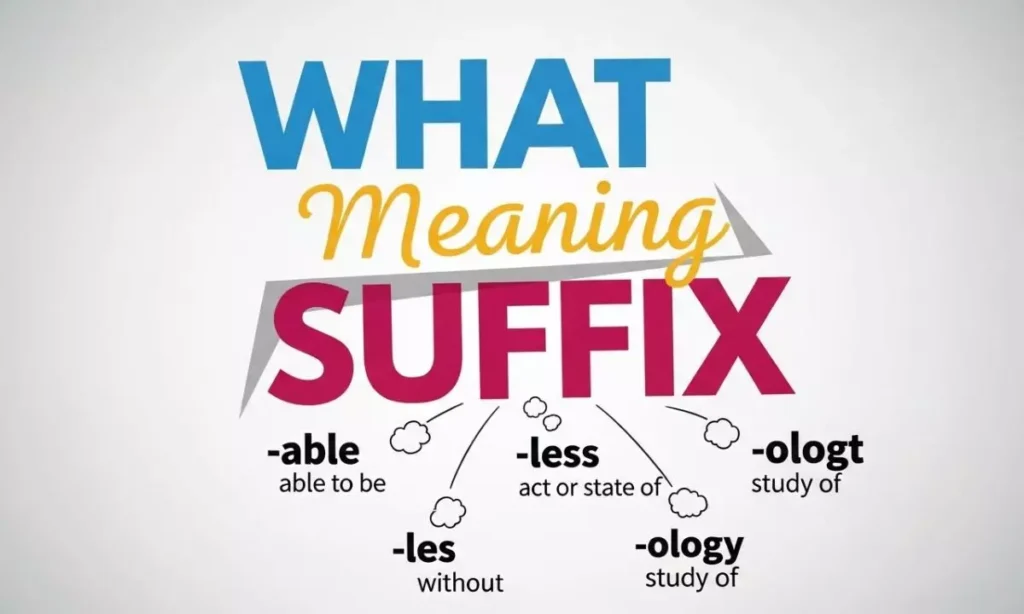
A suffix is a word ending added to the base form of a word to change its meaning, purpose, or grammatical function. Understanding the what meaning suffix concept helps you decode difficult vocabulary and quickly identify how words transform in English. As a learner, recognizing suffix patterns improves reading, writing, and overall communication skills.
Key Points
- A suffix appears at the end of a word
- It can change the meaning or form of the root word
- Helps build a stronger vocabulary
- Common in academic, medical, and everyday English
What Meaning Suffix in English
In English, suffixes are powerful tools that modify the meaning of a word to create new nouns, verbs, adjectives, or adverbs. Mastering suffix meanings supports better sentence construction and helps you understand how English vocabulary evolves.
Useful Details
- Suffixes can show tense, quantity, condition, or description
- Many English suffixes come from Latin and Greek
- Learning them improves word analysis and comprehension
Common English Suffix Table
| Suffix | Meaning | Example | New Word Type |
| able | capable of | readable | adjective |
| ment | action or result | development | noun |
| ity | state or quality | creativity | noun |
What Meaning Suffix Example
Examples make learning suffixes simple and clear. Each example shows how a single word ending changes meaning instantly.
Examples
- Kind + ness becomes kindness meaning the state of being kind
- Enjoy + ment becomes enjoyment meaning the result of enjoying
- Create + ive becomes creative meaning showing creativity
Why Examples Matter
- Help you understand patterns
- Improve memory and vocabulary
- Make complex words easier to decode
What Meaning Suffix in a Sentence
Using suffixes in sentences helps you understand real life application. It shows how a root word transforms into a meaningful new word depending on the suffix.
Sentence Examples
- She showed kindness when she helped the children.
- Their improvement was visible after daily practice.
- He acted responsibly in every situation.
Quick Tips
- Add suffixes only when the word form needs to change
- Watch for spelling changes such as drop e add ing
- Sentence practice strengthens grammar skills
Suffix Definition and Examples
A suffix is a meaningful letter or group of letters added at the end of a root word to change its meaning or function. Suffixes are essential in English grammar, vocabulary building, and word formation.
Important Points
- Turn verbs into nouns or adjectives
- Change a base word into past or present forms
- Help express quality, action, or condition
More Examples Table
| Root Word | Suffix | New Word | Meaning |
| happy | ness | happiness | state of being happy |
| act | ion | action | the process of doing |
| teach | er | teacher | a person who teaches |
What Is My Suffix
A personal suffix is the short word or abbreviation added after your name to show position, order, or family generation. It helps identify individuals with the same name, especially in legal, academic, or professional records.
Key Points
- Used after your full name
- Shows birth order or academic rank
- Helps avoid confusion between similar names
Examples
- John Smith Jr
- David Khan III
- Sarah Lee PhD
Suffix Jr Sr I II III Meaning
These suffixes show generational order in families where names repeat. Each one clarifies identity, lineage, and naming patterns.
Explanation Table
| Suffix | Meaning | Usage |
| Sr | Senior | Original person with the name |
| Jr | Junior | Son with the same name |
| I | First | Used when adding generational numbers |
| II | Second | Grandson or second person with the same exact name |
| III | Third | Third generation with the identical name |
Notes
- II is used when the person is named after an uncle or relative, not necessarily the father
- These suffixes remain part of official documents and signatures
What Meaning Suffix in Tagalog with Example
In Tagalog, a suffix is called hulapi and it is added at the end of a root word to change meaning, tense, or word form. It is a core part of Filipino grammar and helps create verbs, nouns, and descriptive forms.
Key Points
- Common in Filipino verb conjugation
- Helps show action, state, or direction
- Changes the meaning of the root word
Tagalog Examples
- Basa plus han becomes basahan meaning something used for reading or wiping
- Gupit plus an becomes gupitan meaning a place to cut hair
- Araw plus an becomes arawan meaning daily or per day
What Meaning Suffix Name
A suffix in a name is a title or identifier placed after a person’s full name to show generational order, professional qualification, or honorary achievement. These suffixes help distinguish one person from another, especially when names are repeated in families or institutions.
Types of Name Suffixes
- Generational such as Jr, Sr, II, III
- Professional such as MD, PhD, CPA
- Honorary such as OBE or KN
Benefits
- Prevents identity confusion
- Shows qualifications and position
- Used in legal and professional documentation
What Is the Meaning of Prefix and Suffix
A prefix is added at the beginning of a root word, while a suffix is added at the end. Both are essential in English word formation and help expand vocabulary by creating new meanings and grammatical functions.
Clear Difference Table
| Type | Added Where | Example | Meaning |
| Prefix | Beginning of word | unhappy | not happy |
| Suffix | End of word | happiness | state of being happy |
What Is the Meaning of the Suffix itis
The suffix itis is used in medical terminology to describe inflammation of a specific organ or body part. It helps identify health conditions clearly and systematically.
Key Points
- Used in medical and scientific vocabulary
- Means inflammation or irritation
- Common in disease names
Examples
- Arthritis meaning inflammation of the joints
- Gastritis meaning inflammation of the stomach
- Dermatitis meaning inflammation of the skin
What Is the Meaning of Suffix in English
In English, a suffix is a group of letters added at the end of a root word to change its meaning, tense, or grammatical form. Suffixes help create new nouns, verbs, adjectives, and adverbs.
Highlights
- Added at the end of a word
- Forms new word categories
- Changes purpose and meaning
Example Table
| Root Word | Suffix | New Word | Meaning |
| act | ive | active | showing action |
| manage | ment | management | process of managing |
| happy | ly | happily | in a happy manner |
What Is the Meaning of the Suffix ment
The suffix ment is used to form nouns that refer to an action, result, or process. It transforms verbs into meaningful nouns used in daily communication.
Key Points
- Shows action or outcome
- Used after verbs
- Helps create abstract nouns
Examples
- Develop plus ment becomes development meaning the process of developing
- Enjoy plus ment becomes enjoyment meaning the state of enjoying
- Improve plus ment becomes improvement meaning the result of improving
What Is the Meaning of the Suffix osis
The suffix osis is commonly used in medical and scientific terms to describe a condition, disease, or abnormal process. It helps categorize health or biological states.
Key Points
- Refers to a condition or disorder
- Used in clinical and biological words
- Indicates a process or change
Examples
- Tuberculosis meaning a bacterial infection
- Psychosis meaning a mental condition affecting thoughts
- Necrosis meaning tissue death
What Is the Meaning of the Suffix ness
The suffix ness forms nouns that refer to a state, quality, or condition. It transforms adjectives into abstract nouns that describe feelings or characteristics.
Key Points
- Shows a state of being
- Added after adjectives
- Creates descriptive nouns
Examples
- Kind plus ness becomes kindness meaning the quality of being kind
- Dark plus ness becomes darkness meaning the state of being dark
- Weak plus ness becomes weakness meaning lack of strength
What Is the Meaning Suffix
A suffix is a letter or a group of letters added to the end of a word to change its meaning, grammatical function, or form. Understanding the what is the meaning suffix concept helps learners expand vocabulary and improve word recognition skills. Suffixes are widely used in English to form nouns, adjectives, verbs, and adverbs.
Key Points
- Added at the end of a root word
- Alters meaning or creates a new word type
- Common in academic, professional, and everyday English
What Is Meaning Suffix in Punjabi
In Punjabi, a suffix is called ਅੰਤ-ਪ੍ਰਤਿ (ant-prati) and is used to modify the meaning of a root word or to form new words. Suffixes in Punjabi help indicate gender, tense, and plurality, similar to their function in English.
Examples
- ਪਿਆਰ + ਆਲਾ becomes ਪਿਆਰਆਲਾ meaning affectionate person
- ਲਿਖ + ਵਾਂ becomes ਲਿਖਵਾਂ meaning someone who writes frequently
- ਖੁਸ਼ + ਣ becomes ਖੁਸ਼ਣ meaning state of being happy
What Is the Meaning Suffix ment
The suffix ment forms nouns that indicate an action, process, or result. It converts verbs into abstract nouns, making them easier to use in formal writing or professional communication.
Key Points
- Shows the result of an action
- Converts verbs into nouns
- Frequently used in business, education, and literature
Examples Table
| Root Word | Suffix | New Word | Meaning |
| improve | ment | improvement | the process or result of improving |
| enjoy | ment | enjoyment | the state of enjoying |
| develop | ment | development | the process of developing |
What Is the Meaning Suffix and Prefix
A prefix is added at the beginning of a word, while a suffix is added at the end. Together, prefixes and suffixes allow the creation of new words, expand vocabulary, and help understand complex English terms.
Difference Table
| Type | Position | Example | Meaning |
| Prefix | Beginning | unhappy | not happy |
| Suffix | End | happiness | state of being happy |
Why It Matters
- Enhances reading comprehension
- Improves word formation skills
- Used extensively in academic and professional English
What Does Meaning Suffix
The phrase what does meaning suffix refers to understanding the function of a suffix in changing word meaning or form. It helps learners decode unfamiliar words and use them accurately in sentences.
Quick Tips
- Identify the root word first
- Check the suffix to understand the grammatical change
- Practice using new words in sentences to reinforce learning
What Is the Meaning Suffix able
The suffix able is added to a verb or root word to form an adjective, indicating capability, suitability, or possibility. Understanding the what is the meaning suffix able helps learners describe qualities or potential actions in English.
Key Points
- Converts verbs into adjectives
- Shows possibility or capacity
- Widely used in everyday and academic English
Examples
- Read + able = readable meaning capable of being read
- Understand + able = understandable meaning able to be understood
- Manage + able = manageable meaning capable of being managed
What Is the Meaning Suffix in English
A suffix in English is a letter or group of letters added to the end of a root word to change its meaning, create a new word, or alter grammatical function. Learning suffixes strengthens vocabulary and improves reading comprehension.
Key Points
- Placed at the end of a word
- Creates new nouns, verbs, adjectives, or adverbs
- Helps in word formation and sentence building
Common Suffix Table
| Suffix | Function | Example | Meaning |
| able | Capability | readable | can be read |
| ment | Result/action | development | process of developing |
| ness | State/quality | happiness | state of being happy |
What Is the Meaning Suffix ness

The suffix ness converts an adjective into a noun, indicating the state, condition, or quality of the adjective. It is widely used to describe emotions, characteristics, or abstract concepts.
Key Points
- Forms nouns from adjectives
- Expresses state or quality
- Common in descriptive and literary English
Examples
- Kind + ness = kindness meaning the state of being kind
- Dark + ness = darkness meaning the state of being dark
- Weak + ness = weakness meaning lack of strength
What Is the Meaning Suffix er
The suffix er is used to form nouns that indicate a person or thing performing an action, or to form comparative adjectives showing degree. Understanding this suffix enhances vocabulary and descriptive ability in English.
Key Points
- Forms agent nouns (doer of action)
- Forms comparative adjectives
- Common in both everyday and academic language
Examples Table
| Root Word | Suffix | New Word | Meaning |
| teach | er | teacher | a person who teaches |
| write | er | writer | a person who writes |
| tall | er | taller | more tall/comparative form |
Frequently Asked Questions
What is the meaning of suffix in English
A suffix is a letter or group of letters added at the end of a word to change its meaning or grammatical function.
What does suffix mean in grammar
In grammar, a suffix modifies a root word to form nouns, verbs, adjectives, or adverbs and alters the word’s role in a sentence.
What is an example of a suffix
Common examples include -ness in happiness, -ment in development, and -able in readable.
How do suffixes change word meaning
Suffixes can turn verbs into nouns, adjectives into adverbs, or show tense, state, or condition in English words.
What is the purpose of using suffix
The main purpose of a suffix is to expand vocabulary, clarify word function, and create new meanings from root words.
How to identify a suffix in a word
Look at the end of a word for added letters that change the original meaning or form, like -er, -ly, or -ion.
Final Words on What Meaning Suffix
Understanding What Meaning Suffix helps learners decode unfamiliar words and improve communication skills. Suffixes are essential in forming nouns, adjectives, and verbs, making English learning easier and more effective. Mastering them boosts reading comprehension, writing accuracy, and vocabulary growth.

Sarah Mitchell is a creative writer and content enthusiast who believes in the timeless power of words. With a passion for literature and expression, she dedicates her work to crafting relatable and meaningful pieces that inspire and connect with readers.
At ShayariStream, Sarah focuses on curating English Shayari, Quotes, Messages, and Status & Meanings that capture emotions and moments in the most authentic way. Her writing reflects everyday feelings—from love and happiness to motivation and reflection—making it easy for people to find words that truly resonate.
Sarah’s mission is to help readers express their thoughts beautifully, whether it’s through a heartfelt message, an inspiring quote, or a simple status update. Her commitment to quality and creativity ensures that every visitor to ShayariStream leaves with words that add meaning to their lives.